Why Washing Machines Suffer in Malaysia’s Climate
In Malaysia, relative humidity routinely hovers between 75% to 90%, with ambient indoor temperatures averaging 28–34°C. This combination turns the enclosed, dark drum of a washing machine into an ideal breeding ground for black mold (Aspergillus niger), mildew, bacteria, and soap scum (scrud).
Coupled with daily heavy laundry loads—driven by tropical humidity, sweat, and outdoor moisture—our washing machines work significantly harder than those in temperate regions. Without systematic care, machines quickly develop "bau kepam" (a sour, musty laundry odor), degraded rubber seals, clogged drain pumps, and premature motor or bearing failure.
Front-Load vs. Top-Load: Vulnerability Profiles
| Parameter | Front-Load Washing Machine | Top-Load Washing Machine |
|---|---|---|
| Primary Mold Hotspot | Rubber door gasket / bellow folds | Beneath the pulsator wheel & outer tub walls |
| Filter Maintenance | Lower drain pump coin trap filter | Interior mesh or plastic lint filters |
| Water Drain Trapping | Traps ~200–500ml water in pump housing | Residual water sits in bottom drain hose |
| Detergent Sensitivity | Highly sensitive (requires Low-Sud / HE formula) | Moderately forgiving with standard powder |
| Lifespan Threat | Gasket mold, bearing seal corrosion | Suspended rod wear, rusted bottom chassis |
Section 1: The Rubber Gasket & Door Seal Defense (Front Loaders)
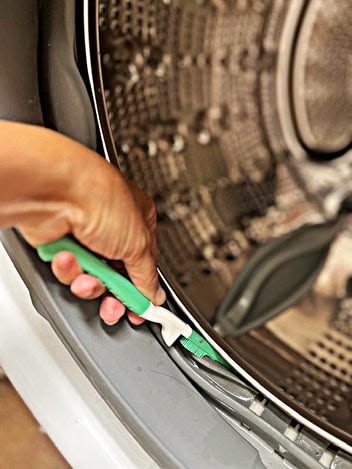
The thick rubber door boot on front-loading washers creates an airtight seal during operation. However, its lower folds collect trapped water, lint, hair, and detergent residue after every wash.
1. The "Golden Rules" of Post-Wash Care
Leave the Door Ajar: Never close the door completely immediately after a cycle. Keep it cracked open at least 5–10 cm to allow humidity to escape and let internal moisture evaporate.
Wipe the Fold: Keep a microfiber cloth hanging near the washer. Wipe down the lower groove of the rubber gasket after the final load of the day.
Check for Trapped Objects: Coins, hairpins, and rubber bands lodge in the gasket drainage holes, blocking runoff and creating stagnant water pools.
2. How to Eradicate Stubborn Black Mold Spots
If black mold spots have already penetrated the silicone/rubber surface:
Mix 1 part liquid chlorine bleach with 1 part warm water (or use 3% hydrogen peroxide for a non-bleach alternative).
Soak paper towels or cotton strips in the solution and tuck them directly into the rubber gasket fold.
Leave them in place for 1 to 2 hours so the chemical agent breaks down the fungal spores.
Remove the paper towels and scrub gently with an old toothbrush.
Run an empty rinse cycle to flush out all chemical residue.
Section 2: Detergent Drawer & Dispenser Cavity Decontamination
Liquid fabric softeners and concentrated liquid detergents leave behind a sticky, glycerine-based film. In humid conditions, this gel hardens into a dark fungal crust inside the detergent drawer housing.
Steps to Clean the Dispenser Assembly:
Release the Lock Tab: Most drawers have a small push-tab marked "PRESS" in the fabric softener compartment. Depress the tab and pull the drawer completely out.
Soak in Warm Water: Submerge the drawer in warm water mixed with dish soap or white vinegar for 15 minutes. Scrub away built-up gel with a stiff brush.
Inspect the Upper Nozzles: Look inside the empty drawer cavity on the machine itself. Water supply nozzles located at the ceiling of the housing often develop algae and limescale. Scrub them with a bottle brush.
Section 3: The Deep Drum & Tub Clean Protocol
Over months of usage, a sticky layer of un-dissolved detergent, body oils, and minerals coats the outer side of the stainless-steel drum—an unseen area where mold thrives undisturbed.
Option A (Commercial Tub Cleaner): Add one full packet of specialized drum cleaning powder (Sodium Percarbonate based).
Option B (DIY Deep Clean): Add 2 cups of washing soda or baking soda directly into the drum, plus 1 liter of white distilled vinegar (or 50g citric acid powder).
Section 4: Drain Pump Filter & Emergency Hose (Front Loaders)
Front-load washing machines feature a drain pump filter located behind a small door at the bottom right front panel. This filter catches lint, hair, coins, and buttons before water enters the pump impeller.
Clearing the Drain Filter:
Prepare a Low-Profile Tray & Towel: Unclipping the filter releases trapped water (~200ml to 500ml). Place a shallow tray directly under the drain cover.
Pull the Emergency Hose: Pull out the small rubber tube, remove its plug, and drain trapped water into your tray. Replace the plug.
Unscrew the Filter: Twist the main filter cap counter-clockwise to remove it.
Remove Obstructions: Clear wrapped hair, lint coils, or coins. Rinse the mesh under running tap water and clean the inner housing.
Tighten Firmly: Reinsert and screw the filter back tightly. A loose filter will cause serious water leaks during the next wash cycle.
Section 5: Water Inlet Filters & Municipal Sediment Protection
Malaysian tap water, particularly after regional pipe maintenance or heavy rainfall, can carry rust particles, fine sand, and silt into home supply lines.
Inlet Mesh Screens: Unscrew the cold water supply hose connected to the back inlet valve of your washing machine.
Pliers Extraction: Use a pair of needle-nose pliers to pull out the small plastic mesh filter seated inside the inlet valve nozzle.
Scrub & Flush: Clean accumulated silt using a toothbrush under a running tap. Clogged inlet filters lead to slow water filling, low pressure errors (E1/4E error codes), and extended cycle times.
Section 6: Combating "Bau Kepam" & Detergent Over-Dosing
The most common operational mistake in local households is using too much detergent. High humidity slows down natural evaporation, so excess soap residue trapped in clothing fibers or machine walls attracts bacterial colonies, creating the infamous bau kepam (sour cloth smell).
Critical Dosing Rules:
Reduce Liquid Detergent Dosage by 25–30%: Modern concentrated liquids require small quantities. Standard laundry loads only need 15–20ml of liquid detergent.
Switch to Low-Sud (HE) Detergents for Front Loaders: Excess suds cushion clothing, preventing effective mechanical agitation, and leave thick films inside the drum.
Limit Fabric Softener Use: Softeners contain silicone-based cationic surfactants that coat fibers and drum walls with a water-resistant film. Use distilled white vinegar in the softener compartment as a natural fabric softener alternative.
Unload Immediately: Never leave washed clothes inside a dark, humid drum for more than 30 minutes after cycle completion.
Maintenance Schedule
| Frequency | Target Area | Action Required |
|---|---|---|
| After Every Wash | Door / Lid & Gasket | Wipe rubber seal dry; leave door open 5–10 cm for air ventilation. |
| Weekly | Detergent Drawer | Pull out drawer, rinse soap residue, wipe inner dispenser housing. |
| Monthly | Main Drum & Tub | Run dedicated Tub Clean cycle with sodium percarbonate or tub cleaner. |
| Every 2–3 Months | Drain Pump Filter | Drain trapped water, unscrew filter cap, clear coins/lint from pump impeller. |
| Bi-Annually | Water Inlet Hose | Remove inlet filter mesh at water inlet valve; clear sand & rust sediment. |
| Annually | Leveling & Hoses | Check spirit level for anti-vibration; inspect rubber supply hoses for cracks/bulges. |